Pray Until God's Voice Reaches Your Soul
- inchristspiration

- Jul 20
- 9 min read
Many prayers stop too soon. They rise from worried lips, carry real pain, ask honest questions, and then end before the heart grows quiet enough to listen.
Prayer is more than sending words toward heaven. It is the holy place where God meets His children, searches them, steadies them, corrects them, and speaks life into what has grown tired. The aim is not merely to reach God’s ears, as though He were far away and hard to persuade. Scripture shows a nearer, kinder truth: God hears before we speak, yet He still invites us to remain with Him until His voice reaches the deep places within us.
Jesus said, “My sheep hear my voice” in John 10:27. That promise is tender and personal. The Good Shepherd does not only receive our cries. He calls, leads, comforts, warns, and restores.
So pray. Pour out your need. Bring the fear. Name the wound. Ask boldly. Then stay. Wait. Let the noise settle. Let the Word of God rise. Let the Spirit bring what your soul could never manufacture on its own.
Do not pray only until you feel heard. Pray until you are changed by the One who hears.

God hears before the first word leaves your mouth
One of the most comforting truths in Scripture is that God is never late to a prayer. He does not need loudness to notice you. He does not need perfect language to understand you. He is not moved by performance, but by mercy, covenant love, and His own faithful character.
Psalm 139 paints a picture of a God who knows our thoughts from far away. Jesus teaches in Matthew 6 that the Father knows what we need before we ask Him. That does not make prayer useless. It makes prayer safe.
You are not entering a courtroom where you must argue your way into compassion. You are entering the presence of a Father.
That means prayer can begin honestly.
You can say:
“Lord, I am afraid.”
“I do not know what to do.”
“I feel far from You.”
“Search me and lead me.”
“Speak, Lord, for Your servant is listening.”
God is not offended by honest weakness. The Psalms are filled with tears, questions, grief, repentance, praise, and silence. David did not hide his soul from God. Hannah prayed through deep anguish. Elijah sat under a tree exhausted. Jeremiah lamented. Jesus Himself prayed in Gethsemane with sorrow beyond measure.
The Bible does not teach polished prayer. It teaches surrendered prayer.
Still, there is a danger in treating prayer only as release. We empty our hearts, then rush back into the same noise that made us weary. We speak, but we do not wait. We ask for guidance, then fill every quiet space with our own anxious thoughts.
God hears every cry, but the soul often needs time to hear Him back.
Prayer becomes communion when we learn to listen
There is a kind of prayer that talks at God. There is a deeper kind that sits with God.
Communion with God does not mean chasing strange signs or forcing a mystical feeling. It means bringing the whole self before Him and becoming attentive to His Word, His Spirit, and His ways.
The prophet Elijah learned this in 1 Kings 19. He saw wind, earthquake, and fire, but the Lord was not in those signs in the way Elijah expected. Then came a gentle whisper. God’s voice met Elijah in quietness.
Many souls want the fire, but God often heals through the whisper.
His voice may reach you through:
A Scripture that exposes fear and gives courage
A conviction that leads to repentance
A peace that does not match your circumstances
A reminder of Christ’s finished work
A prompting to forgive, confess, wait, or obey
A renewed desire to trust Him one more day
God’s voice will never contradict Scripture. The Holy Spirit does not lead people away from Christ, away from holiness, or away from love. He draws attention to Jesus. He brings truth to memory. He produces fruit that looks like Galatians 5: love, joy, peace, patience, kindness, goodness, faithfulness, gentleness, and self-control.
This is why Scripture and prayer belong together. The Bible gives prayer its roots. Prayer helps the Word travel from the page into the soul.
When you pray with an open Bible, you are not trying to invent God’s voice. You are learning to recognize it.
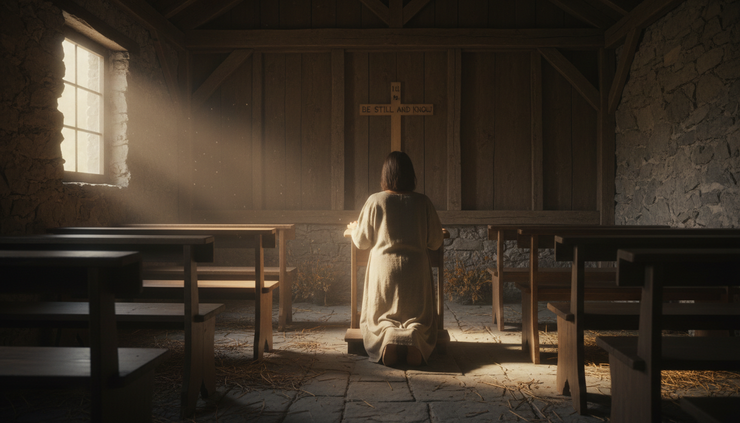
The soul grows quiet through surrender
Listening to God is hard when the heart is gripping everything tightly. Worry speaks loudly. Fear imagines outcomes. Pride prepares defenses. Pain repeats its story until it feels like the only truth.
Surrender does not mean pretending the burden is small. It means placing the burden under the authority of God.
Jesus gives the clearest example. In the garden before the cross, He prayed with deep anguish. He asked the Father if the cup could pass from Him. Then He surrendered: “Not my will, but yours.” That prayer was not passive. It was holy trust in the Father’s will, even when obedience involved suffering.
There are moments when prayer changes circumstances. Scripture testifies to that. God opens doors, heals bodies, provides needs, and makes ways where no human strength can reach.
There are also moments when prayer changes the person carrying the circumstance.
The storm may continue, but panic loses its throne. The question may remain, but despair no longer gets the final word. The road may still require endurance, but the soul begins to walk with a steadier step.
That is one of prayer’s quiet miracles.
God may not answer by explaining everything. He may answer by giving Himself.
And when God gives Himself, the soul receives what it most needs:
Peace deeper than control
Courage stronger than fear
Mercy greater than shame
Wisdom better than impulse
Hope that can survive delay
The longer you remain before God, the more your prayer often changes. At first, you may pray, “Lord, fix this.” Then, as His presence steadies you, the prayer becomes, “Lord, form me here.” Then deeper still: “Lord, be glorified in me.”
That is not defeat. That is worship.
Scripture teaches us to wait without losing faith
Waiting is one of the hardest forms of prayer. It can feel like silence. It can feel like being forgotten. Yet the Bible speaks often of waiting on the Lord, not as resignation, but as active trust.
Psalm 27:14 says to wait for the Lord and take heart. Isaiah 40 speaks of those who wait upon the Lord renewing their strength. Lamentations 3 says the Lord is good to those who wait for Him.
Waiting does not mean doing nothing. It means staying faithful while God works in ways you cannot see.
Think of Samuel as a young boy in the temple. He heard his name and did not understand at first. Eli eventually told him to answer, “Speak, Lord, for your servant hears.” That posture still matters. A listening soul says, “Lord, I am available. I am not here only to get my way. I am here to receive Yours.”
That kind of prayer requires patience because God often speaks in layers. One moment with Him can comfort you. A season with Him can reshape you.
Some prayers are answered with direction. Some with correction. Some with endurance. Some with closed doors. Some with a long obedience that only makes sense when you look back and see His faithfulness behind you.
If you are waiting, do not assume God’s quietness means absence. A seed grows in hidden ground before anything appears above the soil. Roots deepen before fruit arrives.
The Father knows how to speak to His children. Keep showing up.

Pray until the Word becomes personal
There is a difference between knowing a verse and being held by it.
A person can know “The Lord is my shepherd” and still live as though everything depends on self-protection. Then, in prayer, that same truth can settle into the soul until fear loosens its grip. The words become bread. The promise becomes strength. The Shepherd becomes near.
This does not happen by rushing. It happens by abiding.
Jesus used that word in John 15. Abide in Me. Remain in Me. Stay connected like a branch in the vine. Prayer is one of the ways we remain. We come again and again, not because God forgets us, but because we forget the truth when life presses hard.
To pray until God’s voice reaches your soul, try a slower way of praying with Scripture.
Choose one short passage. Read it once for understanding. Read it again with attention. Notice what reveals God’s character. Notice what stirs conviction, comfort, or hope. Then turn the passage into prayer.
If the passage says God is your refuge, pray, “Lord, be my refuge here.”
If it calls you to forgive, pray, “Lord, soften what I have hardened.”
If it reveals Christ’s mercy, pray, “Jesus, help me receive what I keep trying to earn.”
If it commands courage, pray, “Father, teach my heart not to bow to fear.”
Then be still for a few moments. Do not strain. Do not demand a sensation. Sit under the truth. Let it search you. Let it comfort you. Let it confront what needs to change.
God’s voice often sounds like Scripture becoming alive in the exact place where your soul is tired, proud, afraid, or hungry.
The deepest answer to prayer is Christ Himself
Every Christian prayer stands on the grace of Jesus. We do not come to God because our words are strong enough. We come because Christ has opened the way.
Hebrews teaches that believers can draw near with confidence because of Jesus. Romans 8 reminds us that the Spirit helps us in weakness when we do not know what to pray. This means prayer is supported by the whole mercy of God: the Son intercedes, the Spirit helps, and the Father receives.
That truth frees prayer from pressure.
You do not have to impress God. You do not have to speak in perfect phrases. You do not have to feel worthy before you come. You come because Jesus is worthy.
When shame says, “Hide,” Christ says, “Come.”
When fear says, “You are alone,” Christ says, “I am with you.”
When grief says, “Nothing can be restored,” Christ says, “I make all things new.”
When sin says, “This is who you are,” Christ says, “Follow Me.”
The voice that reaches the soul is the voice of the Shepherd who laid down His life for the sheep. He does not crush the bruised reed. He restores. He leads beside still waters. He prepares a table even in the presence of enemies. He calls His own by name.
So the heart of prayer is not technique. It is relationship with the living God through Jesus Christ.
A simple way to remain in prayer longer
Some days, long prayer feels natural. Other days, the mind wanders within seconds. That does not mean prayer has failed. It means the heart needs gentle training.
A simple pattern can help:
Come honestly
Tell God what is true. Do not edit your soul into religious language.
Open Scripture
Let God’s Word guide the conversation. Start with a psalm, a Gospel passage, or a promise you can sit with slowly.
Ask clearly
Bring your requests with trust. Pray for help, healing, wisdom, provision, repentance, courage, and mercy.
Listen quietly
Pause. Breathe. Let the passage remain before you. Notice what the Spirit brings to mind in line with Scripture.
Respond obediently
If God convicts, confess. If He comforts, receive it. If He calls you to act, take the next faithful step.
Return often
Prayer is not only an event. It becomes a rhythm. A soul learns God’s voice through repeated nearness.
This pattern does not force God to speak. Nothing can force God. It simply places the heart in a humble posture where listening becomes possible.

Keep praying until peace has somewhere to land
There are prayers you may need to pray many times. Not because God is reluctant, but because your soul is learning to release what it has carried for too long.
Keep praying when the answer is delayed.
Keep praying when tears come before words.
Keep praying when Scripture feels dry.
Keep praying when you only have enough strength to whisper, “Help me, Lord.”
Keep praying when God’s comfort comes gently instead of dramatically.
The Father is not measuring the eloquence of your prayer. He is forming trust. He is teaching you to recognize the Shepherd’s voice above the noise of fear, shame, anger, and despair.
Do not pray merely to reach God’s ears. Pray until His voice reaches your soul.
Pray until His Word becomes steadier than your worry. Pray until repentance feels like mercy instead of punishment. Pray until surrender becomes less frightening than control. Pray until you remember that you are held by the One who neither sleeps nor abandons His own.
And when you rise from prayer, rise slowly. Carry one word of truth with you. Obey one clear command. Rest in one promise. Take one faithful step.
God has heard you. Now let Him lead you.


Comments